

Ballistic Floatation Vest Market Price Outlook and Future Industry Trends (2026–2036)
Integrated ballistic protection and buoyancy systems redefine maritime personal protective equipment standards
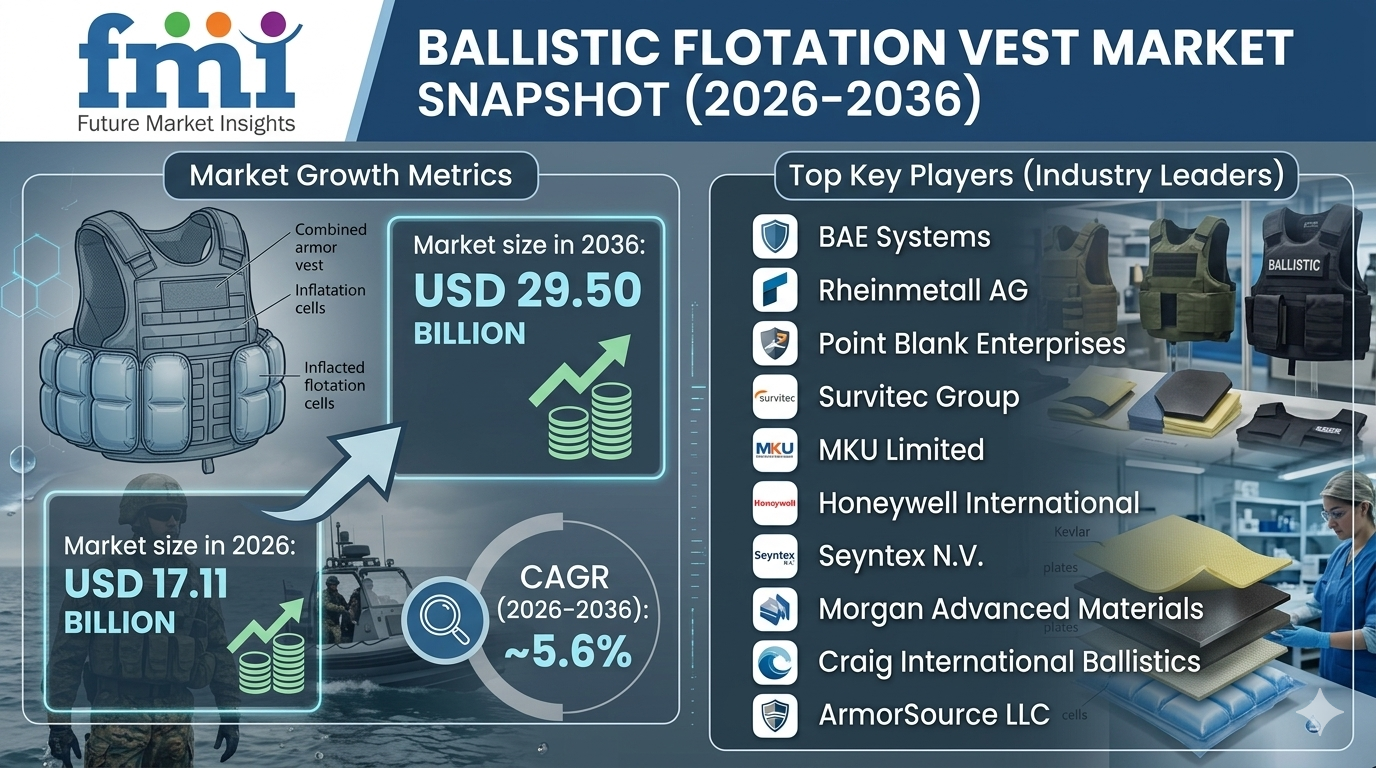
NEWARK, DE, UNITED STATES, March 26, 2026 /EINPresswire.com/ -- The global Ballistic Floatation Vest Market is valued at USD 17.11 billion in 2026 and is projected to reach USD 29.50 billion by 2036, expanding at a CAGR of 5.6% from 2026 to 2036. Growth is driven by naval modernization programs, evolving amphibious warfare doctrines, and increasing demand for integrated protective solutions that combine ballistic resistance with buoyancy.
As maritime forces transition toward multi-functional gear, ballistic floatation vests are evolving from mission-specific equipment into standard-issue protective systems across naval, coast guard, and maritime security operations.
Ballistic Floatation Vest Market Snapshot (2026–2036)
• Market size in 2026: USD 17.11 billion
• Market size in 2036: USD 29.50 billion
• CAGR (2026–2036): ~5.6%
• Leading material type: Ceramic-based systems
• Top coverage segment: Medium coverage vests
• Key application: Naval and maritime force protection
• Fastest-growing country: China
• Key players: Global defense and protective equipment manufacturers
Market Momentum
The Ballistic Floatation Vest Market enters 2026 with strong demand driven by naval procurement cycles and maritime security investments. Between 2027 and 2030, adoption accelerates as integrated vest systems become standard across amphibious and littoral combat units.
From 2031 onward, advancements in material science, including ceramic-composite armor and lightweight buoyancy structures, further enhance product performance. By 2036, the market reaches USD 29.50 billion, supported by sustained defense budgets and expansion into coast guard, port security, and commercial maritime applications.
Request For Sample Report | Customize Report |purchase Full Report - https://www.futuremarketinsights.com/reports/sample/rep-gb-2707
Why the Market is Growing
The market is expanding as defense organizations prioritize multifunctional protective gear that enhances survivability in both combat and aquatic environments. Ballistic floatation vests eliminate the need for separate life jackets and body armor, improving mobility, reducing load burden, and increasing operational efficiency.
Naval doctrine updates requiring continuous protection during amphibious and waterborne missions are a major growth driver. Additionally, procurement strategies are shifting toward integrated systems that meet both ballistic and flotation standards, ensuring compliance with global safety regulations.
Technological advancements in lightweight materials, including ceramic inserts and closed-cell foam structures, are enabling manufacturers to meet stringent performance requirements without compromising comfort. Rising geopolitical tensions and maritime security concerns are further reinforcing long-term demand.
Segment Spotlight
1. Material: Ceramic Systems Lead Demand
Ceramic-based ballistic systems account for approximately 40.2% of market share in 2026. Their superior impact resistance, lightweight properties, and ability to withstand high-velocity threats make them the preferred choice for defense applications.
2. Coverage Area: Medium Coverage Dominates
Medium coverage vests represent around 30.5% of demand, offering an optimal balance between protection and mobility. These configurations are widely adopted for extended missions requiring flexibility and endurance.
3. Thickness: 27 mm Emerges as Standard
The 27 mm thickness segment leads with about 33.7% share, delivering a balance between ballistic protection and buoyancy. It is widely accepted as the industry standard across naval and maritime forces.
Drivers, Opportunities, Trends, Challenges
• Drivers: Naval modernization programs, integrated protection requirements, maritime security concerns
• Opportunities: Advanced composite materials, modular vest systems, expansion into commercial maritime sectors
• Trends: Dual-certification standards, lightweight armor innovation, ergonomic design improvements
• Challenges: Saltwater corrosion resistance, high development costs, stringent certification requirements
Country Growth Outlook (2026–2036)
China leads the market with a CAGR of 7.6%, driven by naval expansion and maritime defense initiatives. India follows at 7.0%, supported by naval modernization and coastal security investments. Germany (6.4%) and France (5.9%) show steady growth through defense upgrades aligned with international standards.
The UK grows at 5.3%, while the United States records 4.8%, reflecting stable procurement cycles. Brazil, at 4.2%, demonstrates moderate growth driven by maritime security spending.
Competitive Landscape
The market is characterized by strong competition among defense equipment manufacturers focusing on advanced material engineering, product durability, and compliance with global standards.
Companies are investing in ceramic composite technologies, corrosion-resistant coatings, and modular designs to meet evolving defense requirements. Competitive differentiation increasingly depends on achieving dual certification for ballistic protection and buoyancy performance, along with maintaining lightweight construction for extended wear.
Frequently Asked Questions (FAQ)
What is the global Ballistic Floatation Vest Market size?
The market is valued at USD 17.11 billion in 2026 and is projected to reach USD 29.50 billion by 2036.
What is the expected growth rate?
The market is expected to grow at a CAGR of approximately 5.6% from 2026 to 2036.
What are ballistic floatation vests?
They are dual-function protective systems combining ballistic resistance with buoyancy for personnel operating in maritime environments.
Why are these vests gaining importance?
They enhance operational efficiency by integrating protection and flotation into a single system, improving safety, mobility, and compliance with modern defense standards.
Explore More Related Studies Published by FMI Research:
AR Windshield Photopolymer Holographic Films Market https://www.futuremarketinsights.com/reports/ar-windshield-photopolymer-holographic-films-market
EV Battery Pack Structural Fasteners Market https://www.futuremarketinsights.com/reports/ev-battery-pack-structural-fasteners-market
Oxalic Acid Market https://www.futuremarketinsights.com/reports/oxalic-acid-market
About Future Market Insights (FMI)
Fture Market Insights, Inc. (FMI) is an ESOMAR-certified, ISO 9001:2015 market research and consulting organization, trusted by Fortune 500 clients and global enterprises. With operations in the U.S., UK, India, and Dubai, FMI provides data-backed insights and strategic intelligence across 30+ industries and 1200 markets worldwide.
Why Choose FMI: https://www.futuremarketinsights.com/why-fmi
Sudip Saha
Future Market Insights Inc.
+1 347-918-3531
rahul.singh@futuremarketinsights.com
Legal Disclaimer:
EIN Presswire provides this news content "as is" without warranty of any kind. We do not accept any responsibility or liability for the accuracy, content, images, videos, licenses, completeness, legality, or reliability of the information contained in this article. If you have any complaints or copyright issues related to this article, kindly contact the author above.
