

Global Ballistic Protection Price Forecast, Supply–Demand Analysis and Market Trends (2026–2036)
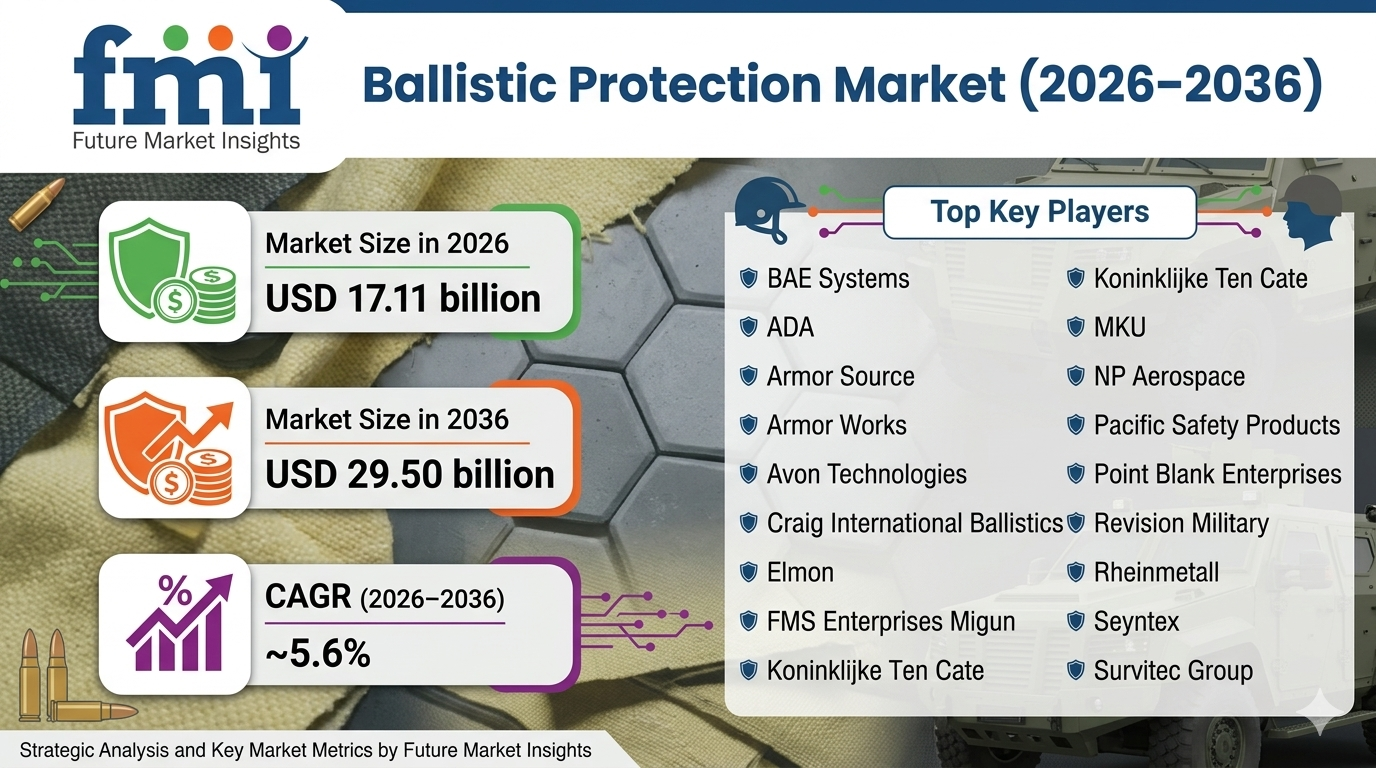
Rising defense budgets, evolving threat landscapes, and modernization programs accelerate global demand for advanced ballistic protection systems
NEWARK, DE, UNITED STATES, March 26, 2026 /EINPresswire.com/ -- The global Ballistic Protection Market is valued at USD 17.11 billion in 2026 and is projected to reach USD 29.50 billion by 2036, expanding at a CAGR of 5.6% from 2026 to 2036. Growth is driven by increasing military modernization initiatives, expansion of law enforcement tactical capabilities, and rising demand for multi-threat protection systems across defense, security, and infrastructure sectors.
As threat environments become more complex, ballistic protection is evolving from single-component equipment into integrated, multi-layered protection ecosystems. These systems combine personal armor, vehicle protection, and structural solutions, positioning ballistic protection as a strategic priority in national security planning and procurement frameworks.
Ballistic Protection Market Snapshot (2026–2036)
• Market size in 2026: USD 17.11 billion
• Market size in 2036: USD 29.50 billion
• CAGR (2026–2036): ~5.6%
• Leading segment: Personal protection equipment
• Top material type: Composite materials
• Dominant technology: Hard armor systems
• Fastest-growing country: China
• Key participants: Global defense and ballistic material manufacturers
Market Momentum
The Ballistic Protection Market begins at USD 17.11 billion in 2026, supported by steady procurement across defense and law enforcement sectors. Between 2027 and 2030, increased geopolitical tensions and defense spending accelerate demand for advanced armor systems, particularly in Asia-Pacific and Europe.
From 2030 onwards, integrated procurement programs and adoption of modular, multi-threat systems drive higher-value contracts. By 2036, the market reaches USD 29.50 billion, with sustained growth supported by infrastructure protection investments and expansion into civilian security applications.
Request For Sample Report | Customize Report |purchase Full Report - https://www.futuremarketinsights.com/reports/sample/rep-gb-23279
Why the Market is Growing
The ballistic protection market is expanding due to rising global security concerns and the shift toward advanced, lightweight, and high-performance protection systems. Military modernization programs are prioritizing soldier survivability, requiring armor solutions that offer enhanced protection without compromising mobility.
Law enforcement agencies are upgrading from basic protective gear to integrated tactical systems, increasing per-officer equipment value. Additionally, critical infrastructure protection—covering airports, embassies, and public buildings—is driving demand for structural ballistic solutions.
Beyond traditional defense use, civilian applications such as VIP transport, private security, and urban safety are contributing to broader market adoption. This diversification is transforming ballistic protection into a multi-sector industry with both public and private demand drivers.
Segment Spotlight
1. Product Type: Personal Protection Equipment Leads Demand
Personal protection equipment accounts for approximately 46% of market share in 2026. Body armor, helmets, and shields dominate procurement volumes due to force expansion and replacement cycles across military and police forces.
2. Material Type: Composites Dominate Market Share
Composites represent around 31% of material demand, driven by their superior strength-to-weight ratio. Materials such as aramid fibers and ultra-high molecular weight polyethylene (UHMWPE) enable lightweight yet highly protective solutions.
3. Technology: Hard Armor Remains Core Segment
Hard armor systems account for nearly 59% of the market, reflecting their critical role in high-risk environments requiring protection against rifle rounds and armor-piercing threats.
Drivers, Opportunities, Trends, Challenges
• Drivers: Defense modernization programs, rising asymmetric threats, infrastructure protection mandates
• Opportunities: Integrated protection systems, civilian security adoption, modular armor solutions
• Trends: Lightweight composite materials, multi-threat protection systems, wearable integration technologies
• Challenges: Regulatory certification complexity, high development costs, export restrictions
Country Growth Outlook (2026–2036)
China leads growth at a CAGR of 7.6%, driven by military modernization and domestic manufacturing expansion. India follows at 7.0%, supported by defense localization initiatives and paramilitary equipment upgrades. Germany grows at 6.4%, backed by NATO alignment and defense spending increases.
France and the United Kingdom maintain steady growth at 5.9% and 5.3%, respectively, while the United States records a moderate 4.8% CAGR due to stable but mature procurement cycles. Brazil expands at 4.2%, supported by military and law enforcement demand.
Competitive Landscape
The ballistic protection market features a mix of global defense contractors and specialized material manufacturers competing on innovation, certification capabilities, and integrated system offerings. Companies are focusing on developing multi-threat protection platforms that combine soft and hard armor technologies.
Competition is increasingly centered on material performance, weight reduction, and the ability to deliver complete protection ecosystems rather than standalone products. Manufacturers investing in advanced composites, ceramics, and modular system integration are gaining a competitive edge in large-scale defense contracts.
Frequently Asked Questions (FAQ)
What is the global Ballistic Protection Market size?
The market is valued at approximately USD 17.11 billion in 2026 and is projected to reach USD 29.50 billion by 2036.
At what rate is the market expected to grow?
The market is forecast to expand at a CAGR of about 5.6% from 2026 to 2036.
What is ballistic protection?
Ballistic protection includes materials and systems designed to defend against bullets, fragments, and blast threats across personal, vehicle, and structural applications.
Why is ballistic protection demand increasing?
Rising geopolitical tensions, modernization of defense forces, and growing need for advanced security solutions across civilian and infrastructure sectors are driving demand.
Explore More Related Studies Published by FMI Research:
Clear Floor Tiles Market https://www.futuremarketinsights.com/reports/clear-floor-tiles-market
Recarburizers Market https://www.futuremarketinsights.com/reports/recarburizers-market
Dimethylolpropionic Acid (DMPA) Market https://www.futuremarketinsights.com/reports/dimethylolpropionic-acid-market
About Future Market Insights (FMI)
Fture Market Insights, Inc. (FMI) is an ESOMAR-certified, ISO 9001:2015 market research and consulting organization, trusted by Fortune 500 clients and global enterprises. With operations in the U.S., UK, India, and Dubai, FMI provides data-backed insights and strategic intelligence across 30+ industries and 1200 markets worldwide.
Why Choose FMI: https://www.futuremarketinsights.com/why-fmi
Sudip Saha
Future Market Insights Inc.
+1 347-918-3531
rahul.singh@futuremarketinsights.com
Legal Disclaimer:
EIN Presswire provides this news content "as is" without warranty of any kind. We do not accept any responsibility or liability for the accuracy, content, images, videos, licenses, completeness, legality, or reliability of the information contained in this article. If you have any complaints or copyright issues related to this article, kindly contact the author above.
