

Global Battery Management System Market to Hit USD 23.3 Billion by 2035, Driven by EV Boom & Smart BMS Innovation
Battery Management System Market Outlook
AI-driven battery systems, EV expansion, and renewable integration accelerate global BMS market growth to USD 23.3B by 2035 at 8.6% CAGR.
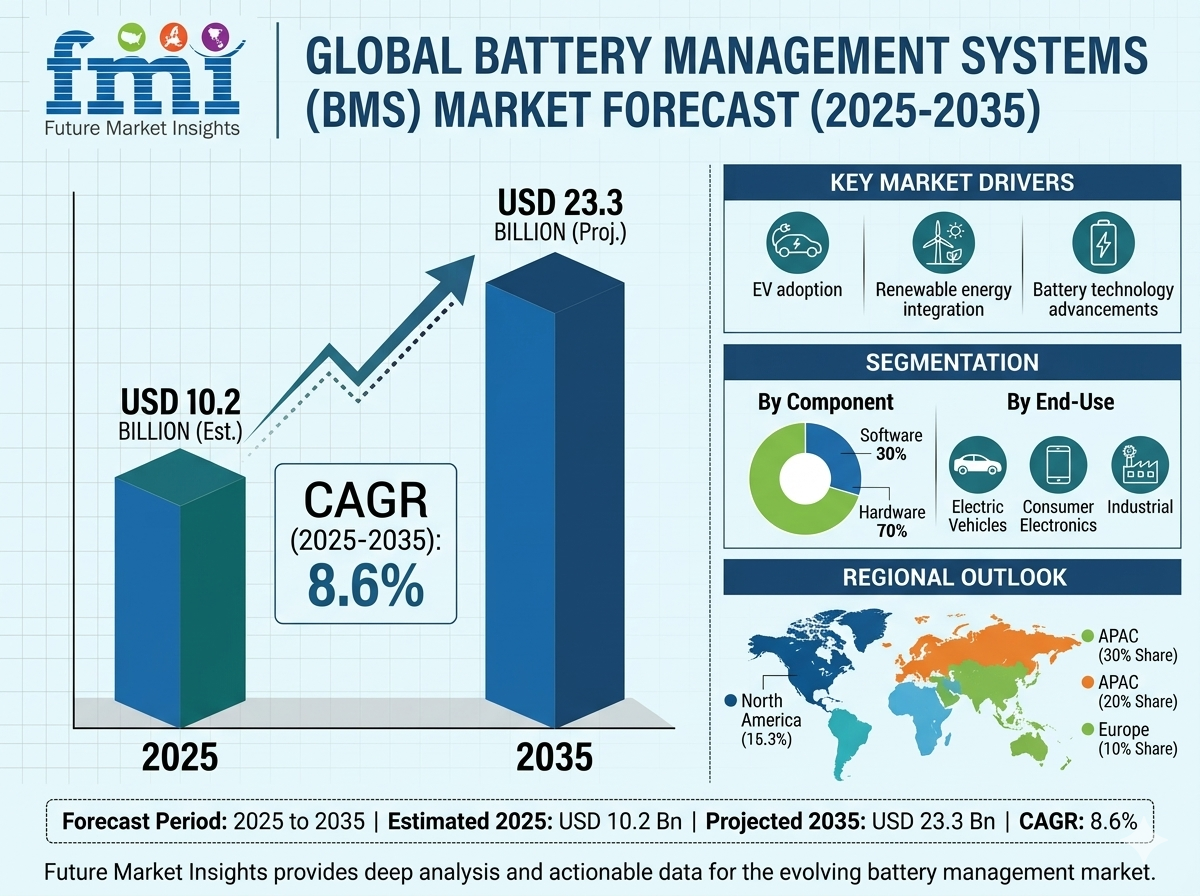
NEWARK, DE, UNITED STATES, March 27, 2026 /EINPresswire.com/ -- The global Battery Management System (BMS) market is valued at USD 10.2 billion in 2025 and is projected to reach USD 23.3 billion by 2035, expanding at a CAGR of 8.6% during the forecast period. Growth is driven by the accelerating adoption of electric vehicles (EVs), increasing deployment of renewable energy storage systems, and rising demand for advanced battery safety and performance optimization technologies across industries.
As global industries transition toward electrification and sustainability, battery management systems are evolving from basic monitoring tools into intelligent energy control platforms. Their ability to enhance battery life, ensure safety, and enable real-time diagnostics positions BMS as a foundational technology across automotive, industrial automation, and next-generation energy ecosystems.
Request For Sample Report | Customize Report | Purchase Full Report
https://www.futuremarketinsights.com/reports/sample/rep-gb-458
Battery Management System Market Snapshot (2025–2035)
• Market size in 2025: USD 10.2 billion
• Market size in 2035: USD 23.3 billion
• CAGR (2025–2035): 8.6%
• Leading battery type: Lithium-ion BMS (44% share)
• Top application segment: Automotive (EV-driven demand)
• Key growth region: China & South Asia
• Emerging trend: AI-enabled and wireless BMS
• Key companies: Global semiconductor, automotive, and energy storage leaders
Market Momentum
The battery management system market begins at USD 10.2 billion in 2025, supported by strong demand from electric vehicle production and renewable energy storage integration. Between 2026 and 2029, advancements in AI-driven analytics, IoT-enabled monitoring, and cloud-connected battery systems accelerate adoption across automotive, telecom, and industrial sectors.
Entering 2030 and beyond, the emergence of wireless BMS architectures, digital twin simulations, and predictive maintenance capabilities reshapes how batteries are managed at scale. Increased deployment of grid-scale energy storage and electrified industrial equipment further strengthens demand.
By 2035, the market reaches USD 23.3 billion, driven by widespread electrification, expansion of smart infrastructure, and increasing reliance on battery-powered ecosystems across transportation, manufacturing, and digital infrastructure.
Why the Market is Growing
The Battery Management System market is expanding as industries prioritize safety, efficiency, and lifecycle optimization of battery-powered systems. BMS solutions play a critical role in monitoring voltage, temperature, and current while ensuring protection against overcharging, overheating, and short circuits.
With the rapid growth of electric vehicles, BMS has become the “brain” of battery packs—ensuring optimal performance, extending driving range, and enhancing reliability. Similarly, renewable energy systems rely on advanced BMS to manage fluctuating energy loads and maintain storage efficiency.
The integration of artificial intelligence, machine learning, and IoT has further transformed BMS capabilities. Real-time data analytics, predictive diagnostics, and cloud-based monitoring enable smarter energy management, reduced downtime, and improved system longevity.
Segment Spotlight
1. Type: Lithium-Ion BMS Leads Market
Lithium-ion BMS holds approximately 44% market share, driven by its widespread adoption in electric vehicles and energy storage systems. Its high energy density and efficiency make it the preferred battery technology globally.
2. Application: Automotive Segment Dominates
The automotive segment is the fastest-growing, with a CAGR of 7.4%, fueled by the rapid expansion of electric vehicles. Increasing EV production globally has significantly boosted demand for advanced BMS solutions.
3. Technology Trend: Smart & Wireless BMS Emerging
Smart BMS integrated with AI, IoT, and wireless connectivity is gaining traction, enabling real-time monitoring, predictive maintenance, and remote diagnostics across applications.
Drivers, Opportunities, Trends, Challenges
• Drivers:
Rising EV adoption, renewable energy integration, industrial automation growth
• Opportunities:
Wireless BMS innovation, AI-driven analytics, smart grid integration
• Trends:
Digital twin technology, cloud-based battery monitoring, IoT-enabled systems
• Challenges:
High initial implementation costs, complex integration, supply chain constraints
Country Growth Outlook (2025–2035)
China leads the global market with a CAGR of 24%, driven by strong EV manufacturing and battery production ecosystems. India follows at 11.2%, supported by government initiatives and rising electric mobility adoption. The United States (8.2%) benefits from defense modernization and EV investments, while Germany (8%) and the UK (7.5%) see steady growth due to renewable integration and telecom infrastructure expansion.
Competitive Landscape
The battery management system market features a competitive mix of semiconductor companies, automotive OEMs, and energy solution providers. Key players are investing heavily in AI integration, sensor technology, and advanced microcontrollers to enhance system performance.
Competition is increasingly centered on innovation in predictive analytics, thermal management, and wireless communication capabilities. Strategic partnerships, acquisitions, and collaborations with EV manufacturers and energy firms are shaping the competitive landscape.
Companies are also focusing on scalable architectures, cloud integration, and sustainability to gain a competitive edge in high-growth regions.
Frequently Asked Questions (FAQ)
What is the global Battery Management System market size?
The market is valued at USD 10.2 billion in 2025 and is projected to reach USD 23.3 billion by 2035.
At what rate is the market expected to grow?
The market is forecast to expand at a CAGR of 8.6% from 2025 to 2035.
What is a battery management system?
A BMS is an electronic system that monitors and manages battery performance, ensuring safety, efficiency, and longevity.
Why is BMS critical for electric vehicles?
It optimizes battery performance, enhances safety, and extends driving range by managing charging and thermal conditions.
Explore More Related Studies Published by FMI Research
Hardware Security Module Market - https://www.futuremarketinsights.com/reports/hardware-security-module-market
Open Banking Market - https://www.futuremarketinsights.com/reports/open-banking-market
Aerial Imaging Market - https://www.futuremarketinsights.com/reports/aerial-imaging-market
About Future Market Insights (FMI)
Future Market Insights, Inc. (FMI) is an ESOMAR-certified, ISO 9001:2015 market research and consulting organization trusted by Fortune 500 companies and global enterprises. With a strong global presence, FMI delivers data-driven insights across industries, helping organizations make informed strategic decisions in an evolving market landscape.
Why Choose FMI:
https://www.futuremarketinsights.com/why-fmi
Sudip Saha
Future Market Insights Inc.
+1 347-918-3531
rahul.singh@futuremarketinsights.com
Legal Disclaimer:
EIN Presswire provides this news content "as is" without warranty of any kind. We do not accept any responsibility or liability for the accuracy, content, images, videos, licenses, completeness, legality, or reliability of the information contained in this article. If you have any complaints or copyright issues related to this article, kindly contact the author above.
