

Global Bamboo Straw Market to Reach USD 2,289.8 million by 2036 | Asia Pacific Leads Production Surge; Jungle Straws
bamboo straw market
U.S. bamboo straw market grows at 8% CAGR, driven by restaurants, cafés, and retail adoption, with rising demand for durable, eco-friendly reusable solutions.
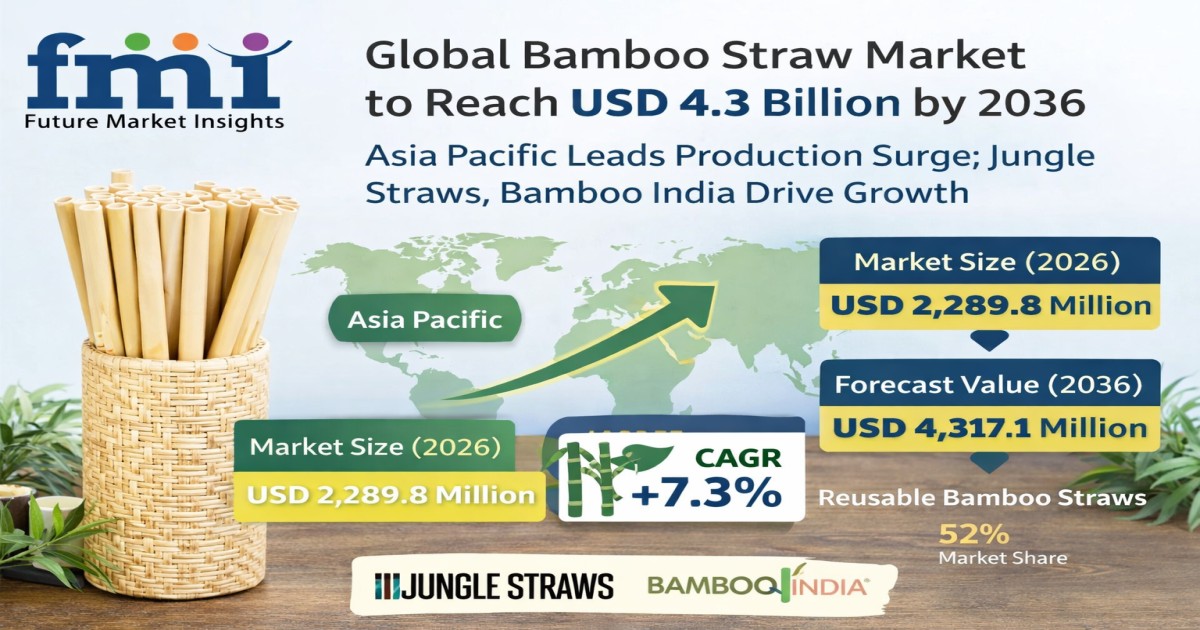
NEWARK , DE, UNITED STATES, April 1, 2026 /EINPresswire.com/ -- The global bamboo straw market is valued at USD 2,289.8 million in 2026 and is projected to reach USD 4,317.1 million by 2036, expanding at a CAGR of 7.3% during the forecast period. This growth reflects a structural transition in the foodservice and consumer goods ecosystem, where procurement strategies are shifting away from single-use plastics toward renewable, reusable materials. Bamboo straws are increasingly positioned not just as alternatives, but as brand-aligned, compliance-driven procurement assets across hospitality, QSR chains, and premium beverage outlets.
Market transformation is being shaped by regulatory bans on single-use plastics, evolving supply chain localization, and advancements in bamboo processing technologies. Governments across Europe, North America, and Asia Pacific are enforcing compliance frameworks that restrict plastic straw usage, pushing operators to adopt natural substitutes.
Bamboo Straw Market: Quick Stats:
• Market Size (2026): USD 2,289.8 Million
• Forecast Value (2036): USD 4,317.1 Million
• CAGR (2026–2036): 7.3%
• Leading Segment: Reusable Bamboo Straws – 52% market share
• Leading End Use: Restaurants & Cafes – 41% share
• Fastest Growing Market: India – 8.7% CAGR
Get Access of Research Report Sample: https://www.futuremarketinsights.com/reports/sample/rep-gb-6936
Market Perspective: Transition from Disposable Utility to Strategic Sustainability Asset
The bamboo straw market is evolving from a low-cost substitute category into a strategic sustainability lever embedded within procurement and branding frameworks. For foodservice operators, bamboo straws are no longer incidental consumables they are visible indicators of environmental compliance and brand positioning.
This shift matters because it directly impacts vendor selection, capex allocation for reusable ecosystems, and compliance reporting. Organizations are increasingly aligning sourcing strategies with ESG benchmarks, where bamboo straws contribute to waste reduction metrics and circular economy targets. As a result, suppliers capable of delivering consistent quality, traceability, and customization are gaining long-term contractual advantages.
Key Growth Drivers:
1. Regulatory Pressure on Single-Use Plastics
Global enforcement of plastic bans is a primary catalyst reshaping procurement decisions. Regulations across the EU, North America, and parts of Asia are mandating alternatives, forcing foodservice operators to rapidly transition. Bamboo straws offer a compliance-ready, biodegradable solution, reducing regulatory risk and enabling smoother operational transitions.
2. Expansion of Foodservice and Beverage Chains
The rapid growth of cafés, QSRs, juice bars, and takeaway beverage formats is driving volume demand. These outlets require durable, visually appealing, and scalable straw solutions that integrate seamlessly into high-throughput service environments. Bamboo straws fulfill both functional and branding requirements.
3. Rising Consumer Preference for Natural Materials
Consumers are increasingly prioritizing eco-conscious consumption, influencing purchasing behavior across dine-in and retail channels. Bamboo straws align with this shift, offering natural aesthetics, reusability, and perceived safety, particularly among urban and environmentally aware demographics.
4. Product Innovation and Quality Standardization
Advancements in antibacterial treatment, polishing techniques, and uniform sizing are addressing earlier concerns around hygiene and consistency. These improvements enhance usability in commercial settings, supporting repeat procurement and long-term adoption across hospitality chains.
Strategic Industry Trends
• Circular Economy Integration: Bamboo straws are becoming part of broader reusable ecosystems, including kits and accessories, supporting waste reduction goals.
• Automation in Processing: Mechanized cutting and finishing are improving output consistency and scalability.
• Material Innovation: Enhanced treatments are improving durability, hygiene, and lifecycle performance.
• Digital Integration: E-commerce and D2C channels are accelerating household adoption and brand visibility.
Segment Insights:
• By Type: Reusable bamboo straws dominate with 52% share, driven by lifecycle cost efficiency and compatibility with cleaning systems.
• By Application: Restaurants & cafés lead with 41% share, as beverage service remains the primary consumption channel.
• By Processing: Antibacterial-treated straws are gaining traction due to hygiene compliance requirements in foodservice.
• By Product Type: Straight and customized-length straws are preferred for operational standardization.
• By End Use: Hospitality and premium dining segments are driving value growth due to higher unit pricing and branding emphasis.
Operational Insights:
Industry Challenges
• Variability in bamboo quality affecting durability and consistency
• Lack of standardization in size and diameter
• Cleaning and maintenance requirements for reusable formats
• Supply chain fragmentation in raw bamboo sourcing
• Limited scalability for smaller manufacturers
Strategic Responses
• Investment in quality control and processing technologies
• Development of standardized product specifications
• Integration of cleaning accessories and reusable kits
• Strengthening supplier networks and sourcing traceability
• Expansion of automated manufacturing capabilities
Regional Outlook:
• Asia Pacific: Dominates production and consumption; India (8.7% CAGR) and China (8.4%) lead due to raw material availability and manufacturing scale.
• North America: Strong demand growth (U.S. at 8.0% CAGR) driven by regulatory enforcement and premium hospitality adoption.
• Europe: Germany (7.1% CAGR) leads with compliance-driven procurement and quality-focused consumption.
• Latin America: Emerging adoption supported by expanding foodservice sectors and rising sustainability awareness.
Competitive Landscape: Consolidation & Capability Advantage
The bamboo straw market is moderately fragmented, with competition driven by quality consistency, sourcing credibility, and customization capabilities rather than scale alone. Companies are focusing on vertical integration, branding, and compliance readiness to secure long-term contracts with foodservice operators.
Key Companies:
• Jungle Straws
• Bamboo Straws Wholesale
• Buluh Straws
• Eco Products
• StrawZ
• Bamboo India
• Bambaw
• Jungle Culture
• GoSili Eco Products
• Simply Straws
Strategic Activities
• Mergers & Acquisitions: consolidating supply chains to ensure raw material security
• Sustainability Investments: Expansion of eco-certified bamboo sourcing and processing
• Capacity Expansion: high-volume processing units in Asia Pacific
• Product Innovation: Launch of treated and customized bamboo straw variants
Future Outlook
The bamboo straw market is expected to evolve into a highly standardized, compliance-driven segment within the broader sustainable packaging ecosystem. Emerging technologies in material treatment, automation, and supply chain digitization will further enhance product consistency and scalability.
As procurement teams increasingly prioritize ESG alignment, lifecycle cost optimization, and regulatory compliance, bamboo straws will transition from niche alternatives to mainstream operational essentials. The integration of bamboo straws into holistic reusable systems will further reinforce their role in long-term sustainability strategies.
Frequently Asked Questions (FAQs)
1. What is the bamboo straw market size in 2026?
The market is valued at USD 2,289.8 million in 2026.
2. What is the forecast value by 2036?
The market is projected to reach USD 4,317.1 million by 2036.
3. What are the key growth drivers?
Regulatory bans on plastics, expansion of foodservice chains, rising eco-conscious consumers, and product innovation.
4. Which segment leads the market?
Reusable bamboo straws lead with 52% market share.
5. Which region is growing the fastest?
India is the fastest-growing market with a CAGR of 8.7%.
Why FMI: https://www.futuremarketinsights.com/why-fmi
Explore More Research Reports by FMI:
Demand for Boxboard Packaging in United Kingdom : https://www.futuremarketinsights.com/reports/united-kingdom-boxboard-packaging-market
Cold Lamination Machine Market : https://www.futuremarketinsights.com/reports/cold-lamination-machine-market
Transparent rPET Market for Beverage Category : https://www.futuremarketinsights.com/reports/transparent-rpet-market-for-beverage-category
Paint Cans Market : https://www.futuremarketinsights.com/reports/paint-cans-market
Tarpaulin Sheets Market : https://www.futuremarketinsights.com/reports/tarpaulin-sheets-market
About Future Market Insights (FMI)
Future Market Insights (FMI) is a globally recognized market research and consulting firm, delivering data-driven insights across industries. With a strong focus on actionable intelligence, FMI supports organizations in navigating complex market transitions and identifying growth opportunities.
Sudip Saha
Future Market Insights Inc.
+1 347-918-3531
rahul.singh@futuremarketinsights.com
Legal Disclaimer:
EIN Presswire provides this news content "as is" without warranty of any kind. We do not accept any responsibility or liability for the accuracy, content, images, videos, licenses, completeness, legality, or reliability of the information contained in this article. If you have any complaints or copyright issues related to this article, kindly contact the author above.
