

Pressure Drops in Pipework — the Hidden Energy Waste
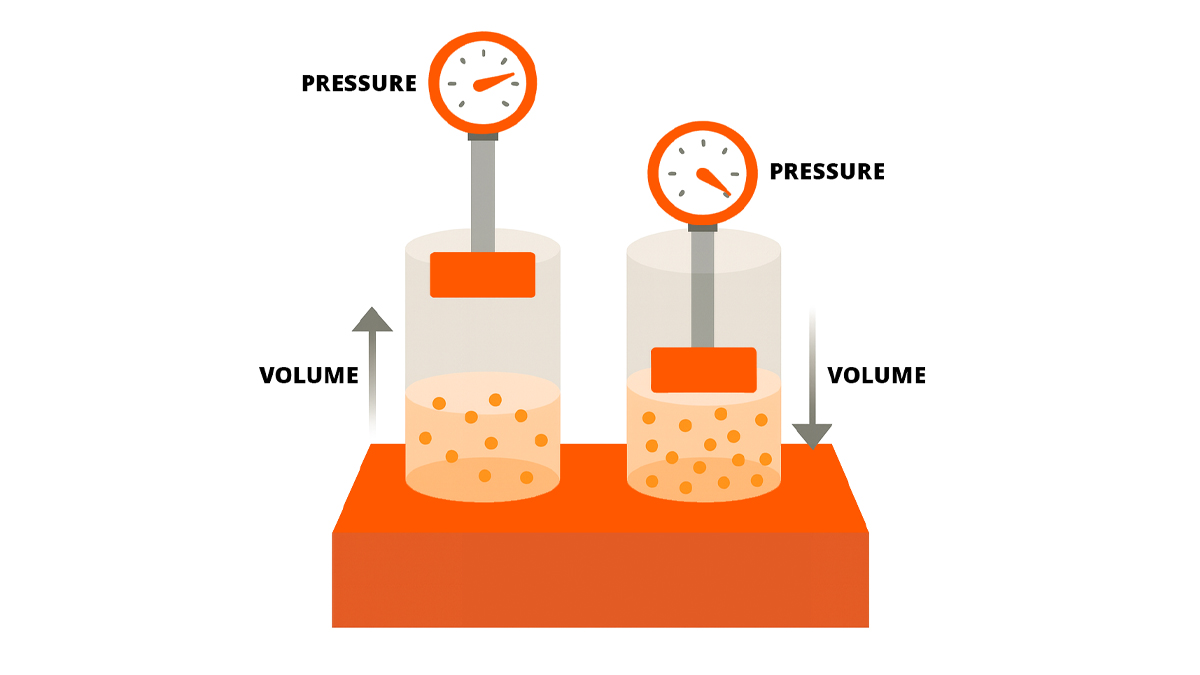
Schematic illustration of the relationship between pressure and volume in a closed system, shown with two cylinders at different compression states.
MAULBURG, GERMANY, July 22, 2026 /EINPresswire.com/ -- In vacuum systems, energy efficiency is often discussed in terms of vacuum pump technology and control strategies. One factor that is frequently overlooked is pressure drop in the pipework and valves between the process and the vacuum pump. Even relatively small pressure losses can have a major impact on the efficiency of the vacuum system.
Why pressure drop matters
Pressure drop is the reduction in pressure that occurs as gas travels through the pipework, fittings, and valves on its way from the process to the vacuum pump. In a vacuum system, this loss forces the vacuum pump to work harder, because the inlet pressure at the vacuum pump is lower than the pressure at the process.
This increased workload can be significant. If the inlet pressure is lower than necessary, the vacuum pump must move a greater volume of gas to achieve the same process conditions. This extra effort translates directly into higher energy consumption.
The energy impact — a real example
To understand why pressure drop has such a big impact, let’s consider a typical application: degassing of bread dough during a mixing process. This process requires a vacuum level of 900 hPa (mbar) below atmospheric pressure of 1013 hPa (mbar). If restrictions in the pipework and valves between the vacuum pump and the process cause a pressure drop of 50 hPa (mbar), the vacuum pump will need to operate at 950 hPa (mbar) below atmospheric pressure to maintain the desired pressure at the process. On the gauge scale (compared to atmospheric pressure), this difference looks small, but on the absolute scale, the effect is much clearer. A process pressure of 900 hPa (mbar) below atmospheric pressure corresponds to 100 hPa (mbar) absolute pressure (abs). In this example with a pressure drop of 50 hPa (mbar) abs, the vacuum pump inlet pressure needs to be 50 hPa (mbar)abs — half of the process pressure. At half the pressure, the same gas load has twice the volume. This means the vacuum pump must handle double the volume flow to maintain the required process conditions, greatly reducing efficiency.
This can increase the power consumption by up to 100% — meaning the system is using twice as much energy as it should for the same process conditions. In this example, the poorly designed connection between the process and the vacuum pump is wasting as much energy as running a second vacuum pump.
What causes pressure drop?
Several factors can contribute to excessive pressure drop in a vacuum system:
• Undersized pipework: Small-diameter pipes create higher resistance to flow.
• Excessive pipe length: The longer the run, the more friction the gas experiences against the inner wall of the pipe as it travels along its length.
• Sharp bends and restrictive fittings: Tight turns, elbows, and sudden changes in diameter create turbulence, which increases losses.
• Incorrectly specified valves: Valves that are too small, poorly designed, or partially obstructed can add significant restriction.
• Overuse of fittings: Each change in direction or pipe cross-sectional area introduces a pressure loss, which can add up.
• Blockages: Carryover from the process, such as the flour from our bread dough mixing example, can build up and form partial blockages, causing a
pressure loss.
How to minimize pressure drop
The most effective way to minimize energy waste from pressure drop is to address it at the design stage. However, existing systems can also often be improved through modifications.
1. Correct pipe sizing
Pipe diameter should be selected based on the required throughput and acceptable pressure drop, not just cost or space constraints. Large-diameter pipes reduce flow resistance and can quickly repay their higher purchase cost through energy savings. However, pipework that is too large can result in excessive evacuation times due to increased internal volume.
2. Optimized layout
Where possible, position the vacuum pump close to the process to minimize pipe length. Avoid routing that requires excessive bends or changes in direction. If bends are unavoidable, use swept elbows rather than sharp right-angle fittings.
3. Minimize obstructions
Avoid unnecessary restrictions in the flow path. This includes choosing fittings that match the internal diameter of the pipework and reducing the number of connectors where possible.
4. Select valves carefully
Isolation, control, and non-return valves should be chosen with both the required throughput and the acceptable pressure drop in mind.
5. Regular inspection and maintenance
Even well-designed systems can develop blockages or restrictions over time due to debris, corrosion, or wear. Periodic inspection can identify issues before they cause performance or efficiency losses.
Beyond energy savings — other benefits
Reducing pressure drop is not just about energy. Lower resistance in the system can also:
• Improve process stability: Fluctuations in pressure are less likely.
• Increase throughput: The vacuum pump can achieve the target pressure faster.
• Reduce wear on vacuum pumps: Less vacuum pump effort means reduced mechanical wear, resulting in a longer lifetime.
• Lower maintenance costs: Systems running under less strain often require less frequent service and fewer repairs.
Summary
Pressure drops in pipework and valves are often invisible until they are measured, but their impact on vacuum system efficiency can be dramatic. A pressure loss of just a few tens of millibars can double the energy consumption of a vacuum system.
The good news is that with careful design — selecting the right pipe sizes, optimizing layouts, and choosing valves to match the application — these losses can be minimized. For existing systems, a review of the pipework can reveal opportunities for improvement that quickly pay back through reduced energy costs.
Dr Sandra Thirtle-Höck
Busch Group
+49 6441 8021460
email us here
Legal Disclaimer:
EIN Presswire provides this news content "as is" without warranty of any kind. We do not accept any responsibility or liability for the accuracy, content, images, videos, licenses, completeness, legality, or reliability of the information contained in this article. If you have any complaints or copyright issues related to this article, kindly contact the author above.
