

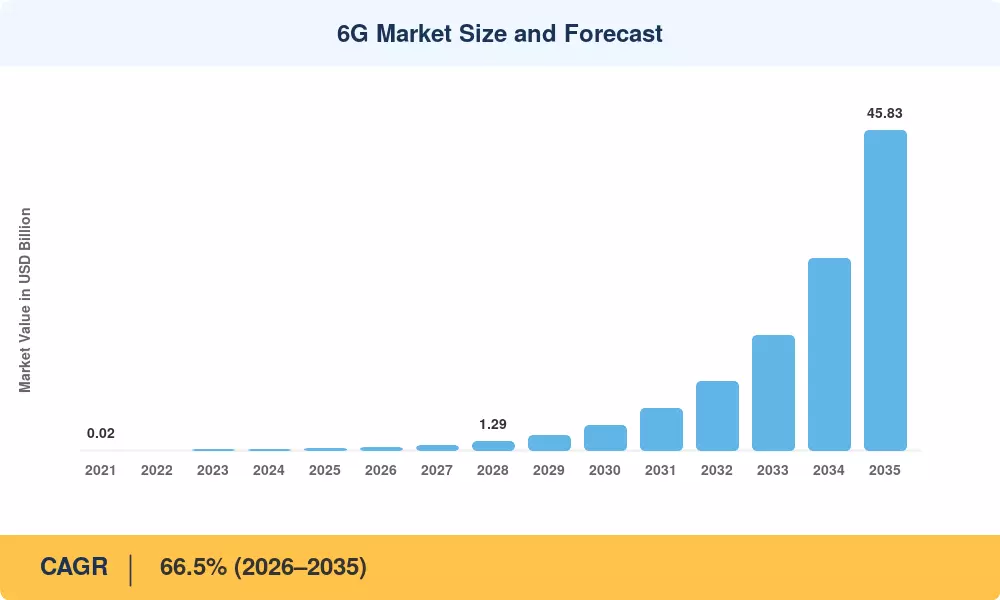
6G Market Expected to Grow to USD 45.83 Billion, with a 66.5% CAGR by 2035
6G Market
6G Market is advancing next-generation connectivity with ultra-low latency, intelligent networks, immersive applications, and advanced wireless technologies.
6G Market development is shaping the future of connectivity through intelligent networks, ultra-low latency, advanced sensing, and immersive digital experiences.”
PARIS, PARIS, FRANCE, September 1, 2026 /EINPresswire.com/ -- The 6G Market is entering a transformative phase as telecom companies, governments, semiconductor manufacturers, and technology innovators invest in next-generation wireless infrastructure. According to Market Research Future, the market was valued at approximately USD 0.28 billion in 2025 and is projected to reach USD 45.83 billion by 2035, expanding at a remarkable 66.5% CAGR during 2026–2035.— Market Research Future
The market is being shaped by advances in artificial intelligence, terahertz communications, edge computing, intelligent networks, and integrated sensing. The broader 6G wireless technology market is expected to support applications that require extremely low latency, high data capacity, intelligent connectivity, and highly reliable communication across industries and connected environments.
Asia-Pacific currently represents the leading regional opportunity, accounting for roughly 39% of global 6G revenue, supported by extensive research programs and spectrum initiatives across China, Japan, and South Korea. The region is also projected to experience one of the fastest growth rates, with an estimated 68% CAGR through 2035.
Get a Sample PDF of the Report at -
https://www.marketresearchfuture.com/sample_request/10951
Rising Demand for Next-Generation Connectivity
The transition from 5G toward 6G is being encouraged by the increasing demand for faster, smarter, and more dependable wireless communication. Emerging applications involving autonomous systems, immersive digital environments, connected transportation, industrial automation, and intelligent infrastructure require capabilities beyond conventional 5G networks. This is creating substantial opportunities for 6G technology providers.
Future networks are expected to combine communication, computing, sensing, and artificial intelligence into a more integrated connectivity environment. The International Telecommunication Union identifies immersive communication, hyper-reliable low-latency communication, massive communication, ubiquitous connectivity, AI and communication, and integrated sensing and communication among the major 6G usage scenarios.
Artificial Intelligence Transforming the 6G Market
Artificial intelligence is expected to become a fundamental component of 6G network architecture rather than simply an additional optimization layer. AI-enabled systems can assist with network planning, traffic management, resource allocation, predictive maintenance, interference control, and dynamic spectrum utilization.
AI-native networking can allow future networks to automatically respond to changing traffic conditions and application requirements. This creates opportunities for software providers specializing in intelligent orchestration, autonomous network management, digital twins, and network analytics. Consequently, the software segment is expected to become increasingly important as 6G infrastructure moves toward programmable and cloud-native architectures.
Terahertz Spectrum and Advanced Wireless Infrastructure
The development of higher-frequency spectrum represents another important factor influencing the 6G Market. Sub-terahertz and terahertz frequencies can potentially provide extremely wide bandwidths, supporting demanding applications requiring very high data throughput.
Sub-terahertz frequencies currently represent a major area of research because they provide a potential pathway toward higher-capacity wireless links while remaining comparatively closer to existing semiconductor capabilities. Terahertz technology is also being explored for advanced sensing and communication applications. However, spectrum harmonization, propagation limitations, semiconductor development, and deployment economics remain important challenges for commercial adoption.
Government Investment Accelerating Market Development
Government-backed research and development programs are playing an important role in advancing 6G technologies. Public funding can reduce research risks while supporting experimental networks, spectrum research, semiconductor development, academic partnerships, and early-stage commercialization.
Countries across Asia, Europe, and North America are developing national or regional strategies around next-generation wireless technologies. These initiatives are encouraging collaboration between telecom operators, universities, equipment manufacturers, chip designers, and technology companies. Such coordinated investment is expected to accelerate innovation and strengthen the global 6G ecosystem.
6G Market Opportunities Across Industries
The potential applications of 6G extend beyond traditional telecommunications. Automotive companies can use high-reliability connectivity for autonomous transportation, vehicle-to-everything communication, and advanced traffic coordination. Manufacturing organizations can use intelligent wireless networks to connect robots, sensors, autonomous vehicles, and digital-twin platforms.
Healthcare is another promising application area. High reliability, low latency, and advanced sensing capabilities could support remote healthcare services, connected medical equipment, real-time monitoring, and future robotic procedures. Smart cities, logistics, agriculture, defense, entertainment, and industrial automation are also expected to contribute to long-term market expansion.
Integrated Sensing and Communication
Integrated sensing and communication is emerging as an important characteristic of future 6G networks. Instead of using communication infrastructure only for transmitting information, 6G systems could simultaneously provide environmental sensing and positioning capabilities.
This convergence could create applications such as high-precision localization, intelligent transportation, industrial monitoring, gesture recognition, and infrastructure awareness. The ITU has identified integrated sensing and communication as one of the six major usage scenarios within its IMT-2030 framework, highlighting its importance in future wireless development.
Non-Terrestrial Networks and Ubiquitous Connectivity
6G development is also expected to strengthen the integration of terrestrial and non-terrestrial networks. Satellites, high-altitude platforms, and other airborne systems could complement conventional cellular infrastructure and help extend connectivity into remote, rural, maritime, and airborne environments.
This convergence can support the goal of ubiquitous connectivity by allowing users and connected devices to remain connected across different network environments. For emerging economies, satellite-terrestrial integration could provide an alternative pathway for extending advanced connectivity without depending entirely on dense terrestrial infrastructure.
Reconfigurable Intelligent Surfaces
Reconfigurable intelligent surfaces are another technology receiving attention in the evolving 6G wireless communication market. These surfaces can manipulate radio signals to improve coverage, manage propagation challenges, and potentially enhance network efficiency.
Their importance could increase at higher frequencies because terahertz and sub-terahertz signals can experience greater propagation limitations. Intelligent surfaces may therefore complement advanced base stations and small-cell deployments by helping redirect wireless signals around obstacles and improve connectivity in complex environments.
Buy Latest Edition of Market Study Now:
https://www.marketresearchfuture.com/checkout?currency=one_user-USD&report_id=10951
6G Market Segmentation
The 6G Market can be analyzed across device type, component, end-user vertical, frequency band, and geographic region. By device type, mobile devices, IoT and edge devices, and other specialized equipment represent key categories. Mobile devices currently account for a significant portion of early market activity because manufacturers are developing future-ready chipsets and prototype hardware.
By component, the market includes hardware, software, and services. Hardware remains important because advanced antennas, radio units, processors, and high-frequency components are required for experimental deployments. However, software is gaining strategic importance because AI orchestration, network automation, virtualization, and programmable infrastructure are becoming central elements of 6G architecture.
By end-user vertical, automotive and transportation, manufacturing and industrial, healthcare, smart infrastructure, entertainment, and other industries represent important opportunities. Automotive applications are particularly significant because connected and autonomous vehicles require reliable communication, precise positioning, and extremely low latency.
By frequency band, the market includes sub-terahertz frequencies between 100 and 300 GHz and higher terahertz frequencies. Sub-terahertz technology currently has a stronger development position, while terahertz research continues to advance toward applications requiring extremely high bandwidth and integrated sensing capabilities.
Asia-Pacific 6G Market Leadership
Asia-Pacific is positioned as a major center of 6G research, investment, and commercialization activity. China, Japan, and South Korea have established significant research initiatives and are actively exploring advanced spectrum, wireless prototypes, semiconductor technologies, and future network architectures.
India is also strengthening its position through national 6G research and industry collaboration. The region's combination of large telecommunications markets, advanced electronics manufacturing, government-backed research, and strong technology ecosystems creates favorable conditions for long-term market development.
North America and Europe Market Outlook
North America represents another important 6G development center, supported by government research, academic institutions, technology companies, telecommunications operators, and open-network initiatives. The United States is particularly active in advanced wireless research involving artificial intelligence, spectrum technologies, and next-generation network architectures.
Europe is focusing strongly on research collaboration, digital sovereignty, sustainability, and advanced telecommunications infrastructure. European programs are supporting research into future wireless standards and technologies while encouraging cooperation among universities, technology companies, and telecom stakeholders.
Key Challenges Facing the 6G Market
Despite significant growth potential, the market faces several barriers. Spectrum allocation remains a major concern because higher-frequency bands require international coordination and suitable regulatory frameworks. Fragmented spectrum policies could increase development costs and complicate global equipment deployment.
Infrastructure investment is another challenge. Building dense networks capable of supporting higher-frequency communications may require significant capital expenditure, advanced semiconductor components, edge computing resources, and sophisticated network management platforms. Cybersecurity, privacy, interoperability, energy efficiency, and standards alignment will also influence adoption.
Competitive Landscape
The competitive environment includes major telecommunications and technology companies such as Samsung Electronics, Nokia, Ericsson, Huawei Technologies, Qualcomm, and Intel. These companies are investing in research covering radio technologies, semiconductor platforms, AI-enabled networks, spectrum solutions, and future communication standards.
Competition is expected to expand as more companies enter specialized areas of the ecosystem. Instead of competing only through traditional network hardware, future vendors may differentiate through AI software, network APIs, sensing technologies, high-frequency components, cloud-native infrastructure, and energy-efficient architectures.
Browse In-depth Market Research Report:
https://www.marketresearchfuture.com/reports/6g-market-10951
Future Outlook for the 6G Market
The future of the 6G Market is expected to move beyond faster mobile broadband toward an intelligent, sensing-enabled, and highly programmable digital infrastructure. AI, edge computing, immersive communication, digital twins, autonomous transportation, industrial robotics, and ubiquitous connectivity are likely to influence demand throughout the forecast period.
As global standards and technical requirements continue to mature, investments made during the research and pre-commercial phases will help determine future technology leadership. The ITU's evolving IMT-2030 framework provides an important foundation for defining the capabilities and performance expectations of next-generation wireless systems.
With the market projected to rise from USD 0.47 billion in 2026 to USD 45.83 billion by 2035, the 6G ecosystem presents substantial opportunities for telecom operators, semiconductor manufacturers, software developers, equipment suppliers, governments, and enterprise technology users.
Frequently Asked Questions About the 6G Market:
What is the 6G Market?
It represents the emerging ecosystem of sixth-generation wireless technologies, infrastructure, devices, software, and services.
How large will the 6G Market become?
MRFR projects the market to reach approximately USD 45.83 billion by 2035.
What is driving 6G Market growth?
AI integration, advanced spectrum technologies, low-latency applications, IoT expansion, and government-supported R&D are major growth factors.
Which region leads the 6G Market?
Asia-Pacific currently leads with approximately 39% of global revenue.
What technologies are important for 6G?
Key technologies include AI-native networking, sub-terahertz communication, terahertz systems, edge computing, RIS, and integrated sensing.
Which industries will benefit from 6G?
Automotive, manufacturing, healthcare, logistics, smart cities, entertainment, agriculture, and defense are among the major potential beneficiaries.
What are the major 6G challenges?
Spectrum allocation, infrastructure costs, semiconductor complexity, cybersecurity, interoperability, and global standards remain important challenges.
When will 6G become commercially important?
Commercial development is expected to progress through the late 2020s and into the 2030s as standards, trials, and infrastructure mature.
➤➤ Regional & Country-Level Reports by Market Research Future:
China 6G Market -
https://www.marketresearchfuture.com/reports/china-6g-market-58407
Gcc 6G Market -
https://www.marketresearchfuture.com/reports/gcc-6g-market-58405
Germany 6G Market -
https://www.marketresearchfuture.com/reports/germany-6g-market-58404
India 6G Market -
https://www.marketresearchfuture.com/reports/india-6g-market-58406
South Korea 6G Market -
https://www.marketresearchfuture.com/reports/south-korea-6g-market-58403
Spain 6G Market -
https://www.marketresearchfuture.com/reports/spain-6g-market-58408
➤➤ Latest Market Intelligence from Market Research Future:
Industrial Computed Tomography Market -
https://www.marketresearchfuture.com/reports/industrial-computed-tomography-market-32313
Industrial Wireline Networking Market -
https://www.marketresearchfuture.com/reports/industrial-wireline-networking-market-32339
Computer Mobile Antivirus Market -
https://www.marketresearchfuture.com/reports/computer-mobile-antivirus-market-32469
High End Accelerometer Market -
https://www.marketresearchfuture.com/reports/high-end-accelerometer-market-32486
Test Data Management Market -
https://www.marketresearchfuture.com/reports/test-data-management-market-32593
Wireless And Mobile Backhaul Advanced Technologies Market -
https://www.marketresearchfuture.com/reports/wireless-and-mobile-backhaul-advanced-technologies-market-32615
Market Research Future
Market Research Future
+1 855-661-4441
email us here
Legal Disclaimer:
EIN Presswire provides this news content "as is" without warranty of any kind. We do not accept any responsibility or liability for the accuracy, content, images, videos, licenses, completeness, legality, or reliability of the information contained in this article. If you have any complaints or copyright issues related to this article, kindly contact the author above.
