

Coala Is Here: Neural4D's CAD AI Agent Turns Prompts into Print-Ready Parts
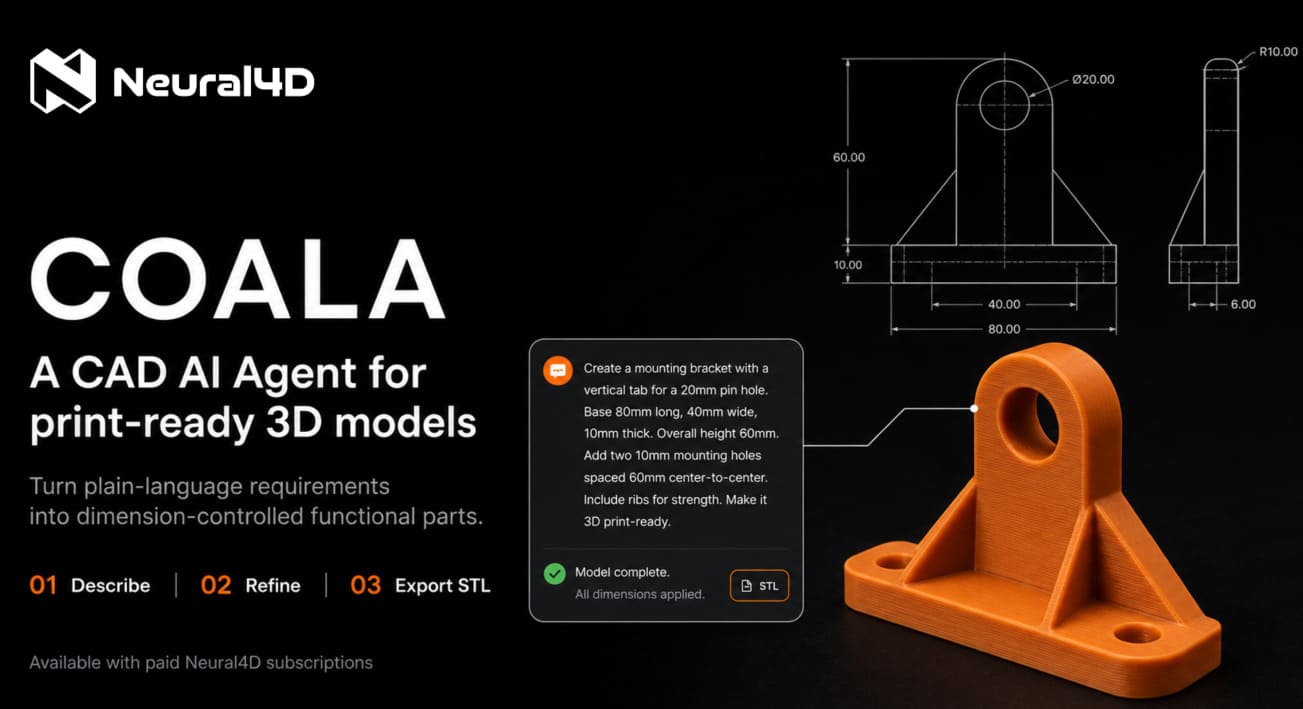
Neural4D's Coala CAD AI Agent turns natural-language requirements into dimension-controlled 3D models for functional design and 3D printing.
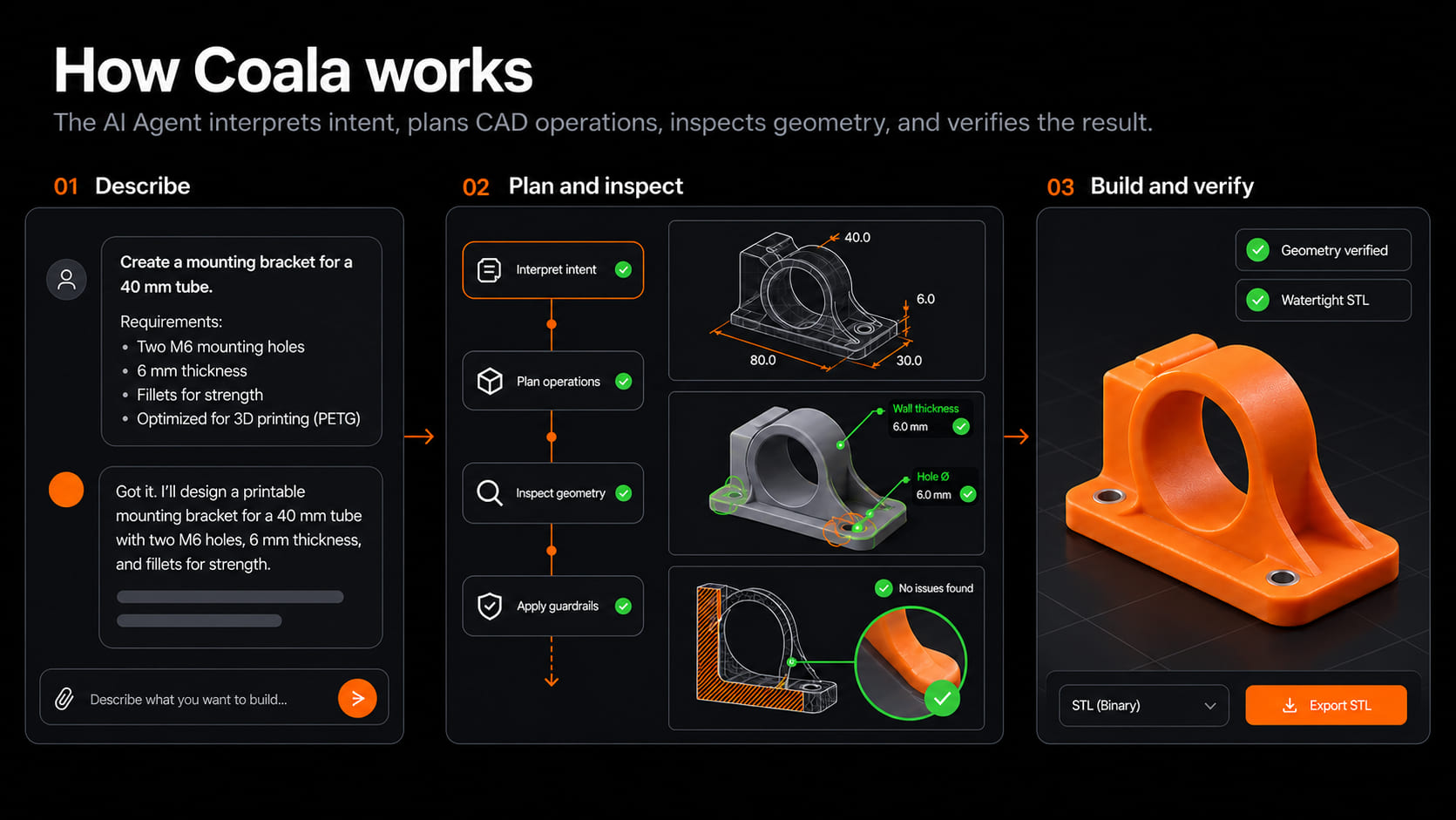
A functional 3D part generated with Neural4D Coala, demonstrating its workflow for creating watertight STL models for 3D printing and rapid prototyping.
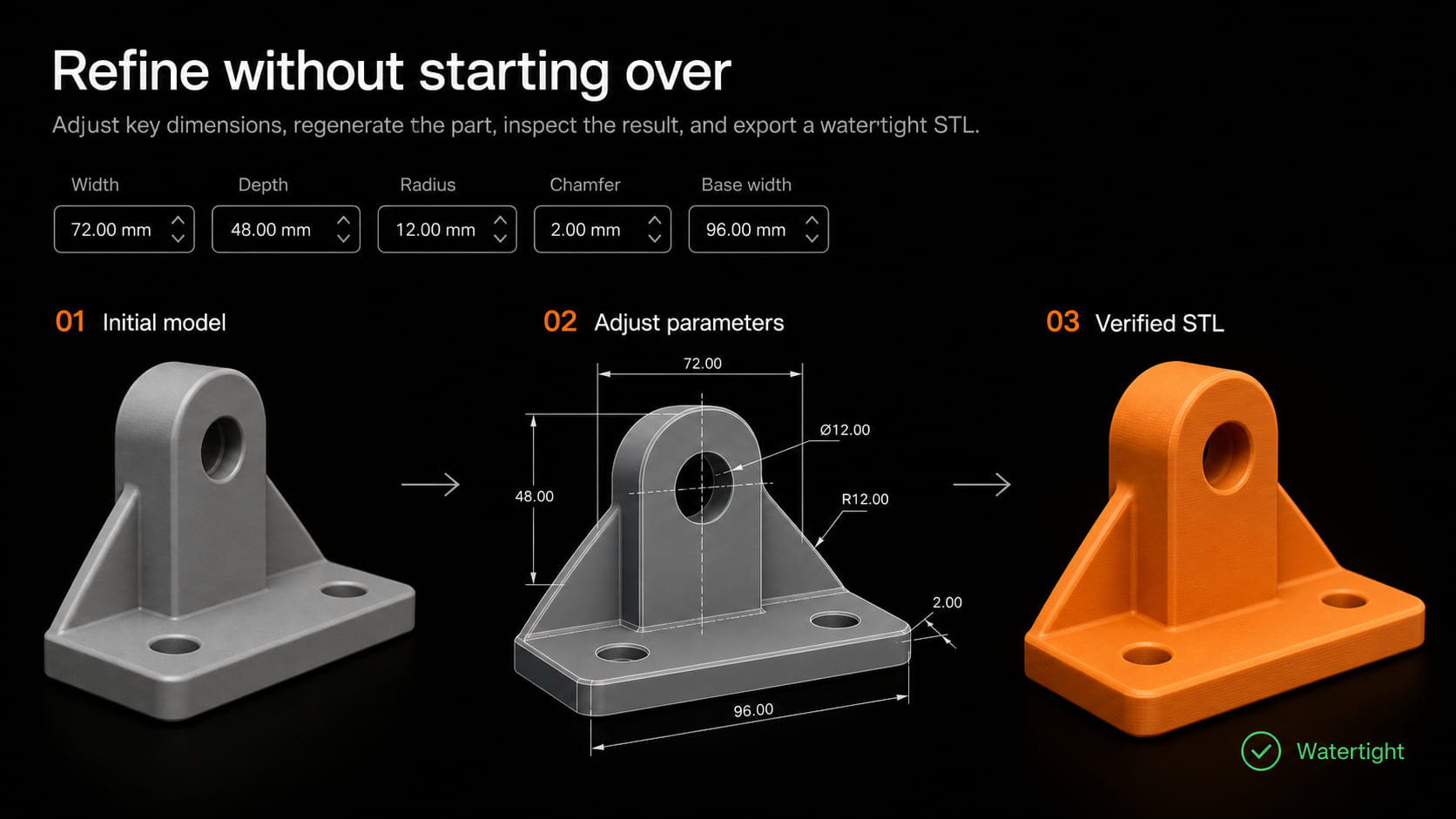
Neural4D Coala lets users refine dimensions and CAD parameters such as width, depth, radius, and chamfer before regenerating the model.
Coala turns natural-language requirements into dimension-controlled, watertight STL models for 3D printing and rapid prototyping.
Coala, a specialized CAD AI agent, begins working when a user describes a component in natural language, such as a mounting bracket with exact hole spacing, a connector with a specified diameter, or an enclosure with a defined wall thickness. The system then produces a 3D model that can be inspected, refined, and exported. Conversational prompts replace the need to memorize commands, while adjustable parameters preserve the dimensional control expected in a CAD workflow.
Development centered on recurring needs voiced by 3D printing users, designers, and engineers: greater control over dimensions, a faster way to refine generated parts, and a clearer path from an idea to a usable prototype.
Rather than acting as a one-shot model generator, Coala interprets the requested part, breaks the job into modeling steps, selects and executes parametric CAD operations, inspects the result, and applies guardrails before presenting the model to the user. This closed-loop process creates a model through a planned and verified workflow, rather than producing a visual approximation from a prompt.
From Prompt to Print-Ready Part
Coala focuses on functional geometry where dimensions matter. After the first model is generated, users can make targeted refinements to individual dimensions and features, adjusting values such as width, depth, radius, chamfer, and base width in a dedicated preview panel. Users can regenerate the model as those parameters change, making it practical to test fit, proportion, clearance, and strength without rebuilding the entire design from the beginning.
The current workflow delivers watertight, manifold STL files for 3D printing and rapid prototyping. Before presenting a model, Coala evaluates geometry integrity and common printability considerations to reduce mesh problems that can interrupt slicing and prototyping. Inspection views help users review the model from multiple angles before preparing downstream documentation. STEP and IGES (.igs) exports are planned to support downstream engineering workflows where users need to continue refining a part in professional CAD software.
Built for Parts That Have to Work
Coala is intended for practical parts such as fasteners, connectors, brackets, enclosures, structural reinforcements, organizers, pixel-style toys, and modular blocks. A 3D printing enthusiast can create a custom replacement or accessory without first mastering a full CAD package. An industrial design student validating a concept can iterate through dimensions while learning how design decisions affect the final geometry. An engineer can rapidly explore a bracket, fixture, housing, or connector before moving into a longer production workflow. Hardware makers can use the same process to prototype accessories and custom components on demand. Coala can also help prototyping teams and 3D printing service providers turn an initial customer requirement into a printable starting point more quickly.
The focus is deliberately mechanical. Coala is not positioned for people, animals, or highly complex organic surfaces, which call for a different type of 3D generation. For users who need functional geometry, it offers a direct path from a design requirement to a printable file in the browser, with no local installation.
"Functional CAD should be accessible to more people, not limited to those who have spent years learning complex software. Coala helps users move from a practical requirement to a printable starting point through conversation, while preserving the dimensional control that real prototyping work demands," said Feihu Zhang, CEO of Neural4D.
An AI Agent, Not Just a Model Generator
Coala runs on N4D's proprietary spatial intelligence stack. Its agent architecture combines intent analysis, task planning, tool execution, result inspection, and safety guardrails in a closed loop. A main agent interprets the user's goal and coordinates expert agents that plan and carry out parametric CAD operations. The system then reviews dimensions, geometry integrity, and printability before presenting the result. Safety and compliance guardrails form part of the same delivery process.
This architecture is designed to make the process more transparent and dependable than direct mesh generation. Each result follows a sequence of intent analysis, planned action, tool use, and verification. A Deep Thinking mode is coming soon, extending Coala's planning and reasoning capabilities for more complex parts and multi-component designs.
Coala is currently available with paid Neural4D subscriptions and uses the platform's Power credits, which serve as usage units for AI generation tasks. Paid plans provide higher concurrency and discounted credit rates. N4D also provides new users with 50 Power credits each week to explore eligible platform features.
About Neural4D
Neural4D is an AI-powered creative platform developed by DreamTech, offering a full suite of generative tools including Text to 3D, Image to 3D, Text to Image, Text to Video, and AnimeArt. Built on proprietary spatial intelligence technology, the platform serves creators and businesses across gaming, e-commerce, AR/VR, design, and digital entertainment. Its mission is to empower creators worldwide to bring their ideas to life, from the first visual concept to the final production-ready asset.
DreamTech Company
Neural4D
email us here
Visit us on social media:
LinkedIn
Instagram
Facebook
YouTube
TikTok
X
Other
Legal Disclaimer:
EIN Presswire provides this news content "as is" without warranty of any kind. We do not accept any responsibility or liability for the accuracy, content, images, videos, licenses, completeness, legality, or reliability of the information contained in this article. If you have any complaints or copyright issues related to this article, kindly contact the author above.
