

New Preprint: Engineered On-Board Hypoxic Living Environments for Astronaut Health and Deep-Space Radiation Protection
www.biogerontology.info/space-radiation-preprint
Research effort led by Biogerontology Research Foundation with coauthors from NASA Johnson Space Center, Cedars-Sinai, Broad Institute of MIT & Harvard & others
On-board hypoxic radioprotection must move now from concept to mission-critical astronaut-health infrastructure. Deep-space crew safety demands that we act before mission architectures are fixed.”
LONDON, UNITED KINGDOM, September 29, 2026 /EINPresswire.com/ -- The Biogerontology Research Foundation (BGRF), together with Oxy Wave Foundation, has announced a new scientific article preprint co-authored by an international team of collaborators from 17 institutions, which focuses on a fundamental challenge for deep-space exploration: protecting astronaut health through the environments crews live in. — Dr. Arkadi Prokopov, physician & lead author on the paper; Founder, OXYESTA
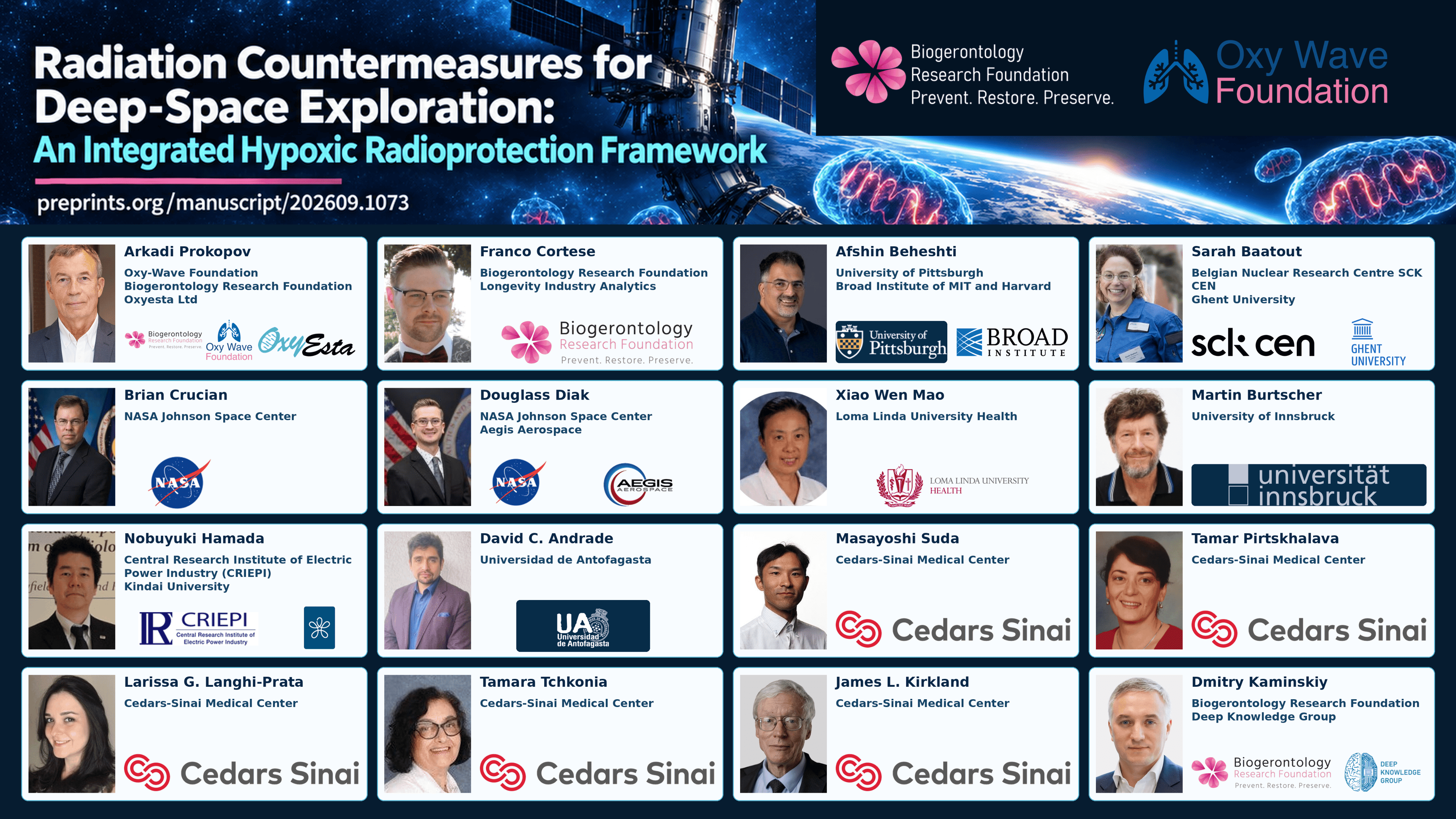
The collaboration's new preprint, "Radiation Countermeasures for Deep-Space Exploration: An Integrated Hypoxic Radioprotection Framework," places controlled hypoxic/hyperoxic environments, mitochondrial resilience and biological radiation protection at the centre of that effort, and brings together co-authors from NASA Johnson Space Center, Cedars-Sinai Medical Center, the Broad Institute of MIT and Harvard, The Belgian Nuclear Research Center, Ghent University, Loma Linda University, the University of Innsbruck, Kindai University and others.
Read the preprint here: www.preprints.org/manuscript/202609.1073
The paper's central proposal is that oxygen partial pressure inside spacecraft and planetary habitats should be treated as an active mission-health parameter, rather than only a fixed life-support setting. The paper sets out a two-level architecture for study: moderate baseline habitat hypoxia, approximately 16-12% oxygen, combined with deeper monitored excursions around 9-10% oxygen during solar-particle-event sheltering, integrated with shielding, dosimetry, biomedical monitoring and other countermeasures.
The framework focuses on mechanisms by which oxygen availability can influence radiation injury, including oxygen-dependent fixation of DNA damage, oxidative stress, mitochondrial function and cellular senescence. It also addresses the operational questions that would determine whether such an approach can move from concept to mission use, including cognitive and cardiovascular safety, physiological monitoring, fire-safety implications, crew adaptation and integration with environmental-control and life-support systems.
The paper also features preliminary human biomarker data from three astronauts who flew on Axiom Mission 1, the first all-private astronaut mission to the International Space Station. The exploratory observations include post-flight changes in p16INK4a-associated T-cell senescence markers and several circulating senescence-associated secretory phenotype factors, adding a human-spaceflight biology component to the broader radioprotection framework.
The work extends a research direction first articulated by the Biogerontology Research Foundation in the 2018 Oncotarget paper "Vive la radiorésistance!: converging research in radiobiology and biogerontology to enhance human radioresistance for deep space exploration and colonization" (DOI: 10.18632/oncotarget.24461), an international collaboration led by the BGRF that connected scientist collaborators from 30 institutions internationally including NASA Ames Research Center, Health Canada, Belgian Nuclear Research Centre, Canadian Nuclear Laboratories, Oxford University, Johns Hopkins, University of Liverpool, Boston University, University of Copenhagen, Ghent University and others. The new preprint moves that discussion toward engineered habitat environments and a defined validation pathway intended to connect radiobiology, oxygen physiology, mitochondrial resilience and spacecraft-system design.
The Biogerontology Research Foundation and Oxy Wave Foundation regard controlled hypoxic environments as an urgent and substantially underfunded and inadequately prioritized high-value area of astronaut-health research. Their position is that engineered oxygen environments should not be treated as a peripheral or merely complementary intervention, but investigated as a potentially fundamental layer of mission-health architecture for long-duration human spaceflight. They also argue that scientific attention, development funding and mission-planning prominence have not yet matched the potential significance and practical implementability of this approach.
The preprint therefore sets out a staged development pathway rather than stopping at the conceptual proposal. Priorities include mechanistic validation, controlled human-performance studies, determination of safe exposure parameters, prototype habitat and life-support integration, and eventual mission-relevant testing. The organizations are now engaging scientists, medical and research institutions, space agencies, aerospace companies, life-support developers and other potential partners to refine the framework, test its limits and accelerate progress toward deployable systems.
A related follow-on research effort is also being developed to examine how controlled oxygen environments, mitochondrial resilience and related adaptive mechanisms may translate to terrestrial health and Longevity applications. Researchers with relevant expertise, including oxygen physiology, mitochondrial biology, radiation biology, aerospace medicine and controlled-environment systems, are being considered for that next phase.
The preprint is co-authored by Arkadi Prokopov (Oxy Wave Foundation), Franco Cortese (Biogerontology Research Foundation), Afshin Beheshti (Broad Institute of MIT and Harvard), Sarah Baatout (SCK CEN), Brian Crucian and Douglass Diak (NASA Johnson Space Center), Xiao Wen Mao (Loma Linda University), Martin Burtscher (University of Innsbruck), Nobuyuki Hamada (Kindai University), David C. Andrade (Universidad de Antofagasta), Masayoshi Suda, Tamar Pirtskhalava, Larissa G. Langhi-Prata, Tamara Tchkonia and James L. Kirkland (Cedars-Sinai), and Dmitry Kaminskiy (Deep Knowledge Group).
Iain Inkster
BIOGERONTOLOGY RESEARCH FOUNDATION
email us here
Visit us on social media:
LinkedIn
Legal Disclaimer:
EIN Presswire provides this news content "as is" without warranty of any kind. We do not accept any responsibility or liability for the accuracy, content, images, videos, licenses, completeness, legality, or reliability of the information contained in this article. If you have any complaints or copyright issues related to this article, kindly contact the author above.
